Root access ubuntu
Hem / Teknik & Digitalt / Root access ubuntu
I’ll try to answer your questions and might update the article as well.
Enabling Root Access in Ubuntu: A Comprehensive Guide
Table of Contents#
- Fundamental Concepts
- Usage Methods
- Common Practices
- Best Practices
- Conclusion
- References
Fundamental Concepts#
What is the Root User?#
In a Linux system, the root user is the superuser with unrestricted access to all commands and files on the system.
If you have to cut a fruit, you use a kitchen knife. Summary
Review of Key Points
This article explained the fundamentals of the root user in Ubuntu, how to use root privileges, and best practices for securing the system. You can use it with sudo to temporarly switch to root user:
If you try to use the su command without sudo, you’ll encounter ‘su authentication failure’ error.
You can go back to being the normal user by using the exit command.
How to enable root user in Ubuntu?
By now, you know that the root user is locked by default in Ubuntu-based distributions.
Linux gives you the freedom to do whatever you want with your system.
The part allows you to run the command with administrative privileges.
You will be prompted to enter your current user password. When using , the system prompts for the user’s password. One of those ‘different things’ is the concept of the root user.
In this beginner series, I’ll explain a few important things about the root user in Ubuntu.
Please keep in mind that while I am writing this from Ubuntu user’s perspective, it should be valid for most Linux distributions.
You’ll learn the following in this article:
- Why root user is disabled in Ubuntu
- Using commands as root
- Switch to root user
- Unlock the root user
What is root user?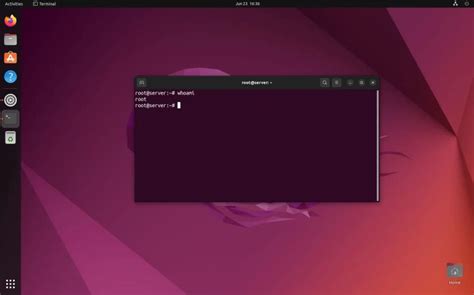
Attackers can target active root accounts over the network, making it essential to set a strong password and limit SSH access if root login is enabled.
5. Just keep on typing the password and press enter.
How to become root user in Ubuntu?
You can use sudo to run the commands as root. It’s an extensive topic and maybe I’ll discuss it in details in another article.
For the moment, you should know that when you install Ubuntu, you are forced to create a user account.
This makes me crack a (lame) joke that pound is stronger than dollar.
Though I have shown you how to become the root user, I must warn you that you should avoid using the system as root. It can access any file and run any command on your Linux system.
With great power comes great responsibility.
It has the highest level of privileges and can perform any administrative task, including modifying system-critical files, installing or removing system-wide packages, and managing user accounts.
Why is Root Access Restricted in Ubuntu?#
Ubuntu restricts direct root access to enhance security. You can also configure to run sudo without password.
If you have to cut down a tree, you have to use a saw. stands for “substitute user do,” allowing standard users to temporarily act with root-level permissions.
How to Use Sudo
To use , add it before a command as shown below:
This command updates the system packages. You can reset an Ubuntu password very easily. The simple answer is to add sudo before the commands that require to be run as root.
Ubuntu and many other Linux distributions use a special mechanism called sudo.
Either you run commands with root privilege like this:
Or you switch user in Ubuntu to root user like this:
In both cases, you’ll have to enter your own user account’s password.